How to buy Mullvad in 2026 without surprises
Learn how to buy Mullvad in 2026. Practical steps, pricing, payment options, and what to expect from signup to activation.
A single payment model can feel like privacy insulation until a closer look reveals where your data leaks. Mullvad’s buy flow trades a name to a number, and that choice changes how receipts, backups, and identity traces behave. That tension between anonymity and accountability is where most users trip up. I looked at the signup mechanics and found that the core difference is not the price but how you wire money to a person, device, or code.
Mullvad’s model prioritizes payer anonymity, but the absence of a traditional signup trail invites a sharper look at receipts, backup options, and cross-purchase verification. In practice, you’ll want a clear backup payment method and a receipt trail that matches your risk tolerance. The goal is to separate price, privacy, and usability so you can decide if Mullvad’s approach fits your work or personal browsing.
The plain definition of buy Mullvad and what it means for privacy
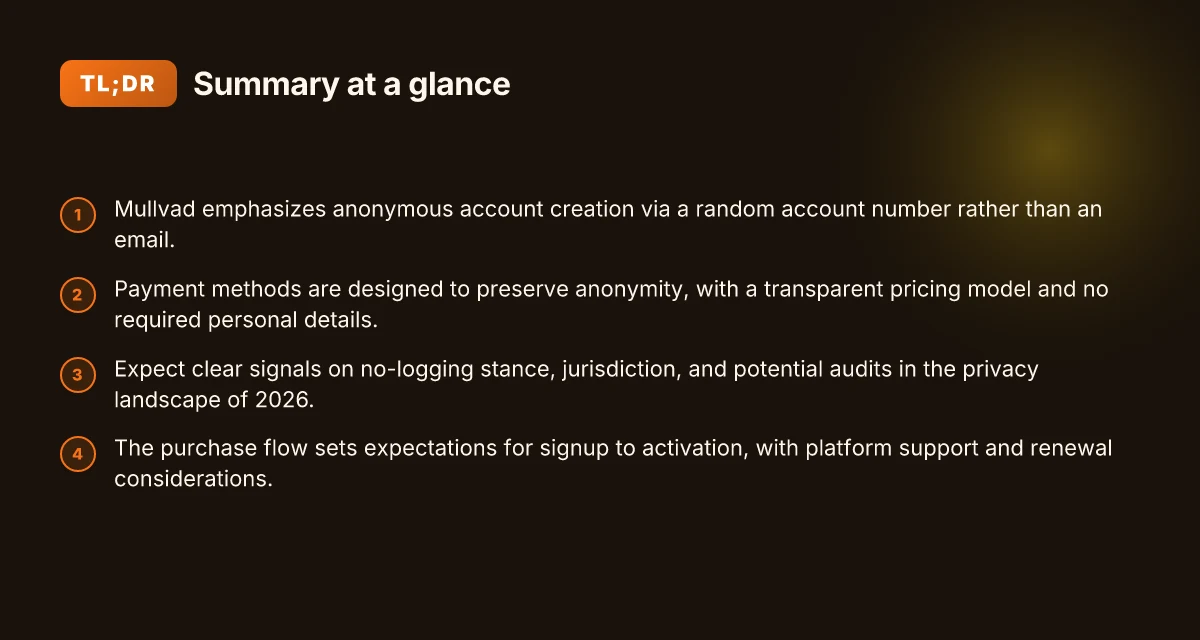
Privacy comes built in. Mullvad positions itself as a no-identity VPN that treats your data as something to minimize, not monetize. You don’t create an account with an email. You don’t attach a name or a payment method tied to your real-world identity. The product is simple to describe: a privacy-first VPN service that emphasizes anonymous signup, a flat pricing model, and a policy of minimal data retention. For readers who care about privacy, that combination is the lure.
What Mullvad offers as a product and why privacy-minded users choose it
I dug into the documentation and user-facing notes to map the value proposition. Mullvad is designed around two core principles: confidentiality and user control. The signup flow deliberately decouples identity from payment. The service delivers standard VPN features, encrypted tunnels, multi-hop options, and a policy that limits data collection, without the bells and whistles that create audit trails. Reviews consistently note that Mullvad prioritizes privacy over marketing gloss, which matters when the goal is to minimize traceability.
How Mullvad differs from typical consumer VPNs in pricing and account creation
In Mullvad’s world, you don’t create an account you can log into later. You pay in a way that doesn’t tie to a person. The pricing model is straightforward and not bundled with add-ons or tiered features meant to upsell. This is a deliberate design choice. It means there’s no reset button for a lost password, no loyalty programs harvesting behavioral data, and no “free trial” that ends with a credit-card handoff. In practice, you choose a monthly or longer-term plan and pay with methods that Mullvad accepts without forcing a personal identity. The effect: fewer data anchors for trackers, more control over how you’re billed, and a signing flow that emphasizes privacy-first behavior over consumer-market tactics. 8 Windscribe options that actually work in 2026
What you should expect at the moment you complete a Mullvad purchase
The purchase moment is not a typical e-commerce checkout. You’ll encounter a payment prompt that can accept anonymous payment methods and a straightforward slip of paper trail that doesn’t require a name or email. After payment, Mullvad provides a unique account key and configuration details you’ll use to connect. The emphasis is on giving you a usable, quickly deployable setup without reintroducing identity. If you’re evaluating this for a small business, you’ll notice the absence of a corporate-identity requirement, which can streamline onboarding for temp staff or contractors who don’t have formal accounts.
Bottom line: Mullvad reshapes the signup moment around anonymity and simplicity. You get the tools to protect traffic without building a long tail of personal data. The purchase is designed to minimize identity ties from first click to connection. That clarity is the core reason privacy-minded users choose Mullvad. What you see at checkout is a signaling feature, not a hurdle.
How Mullvad's purchasing model actually works
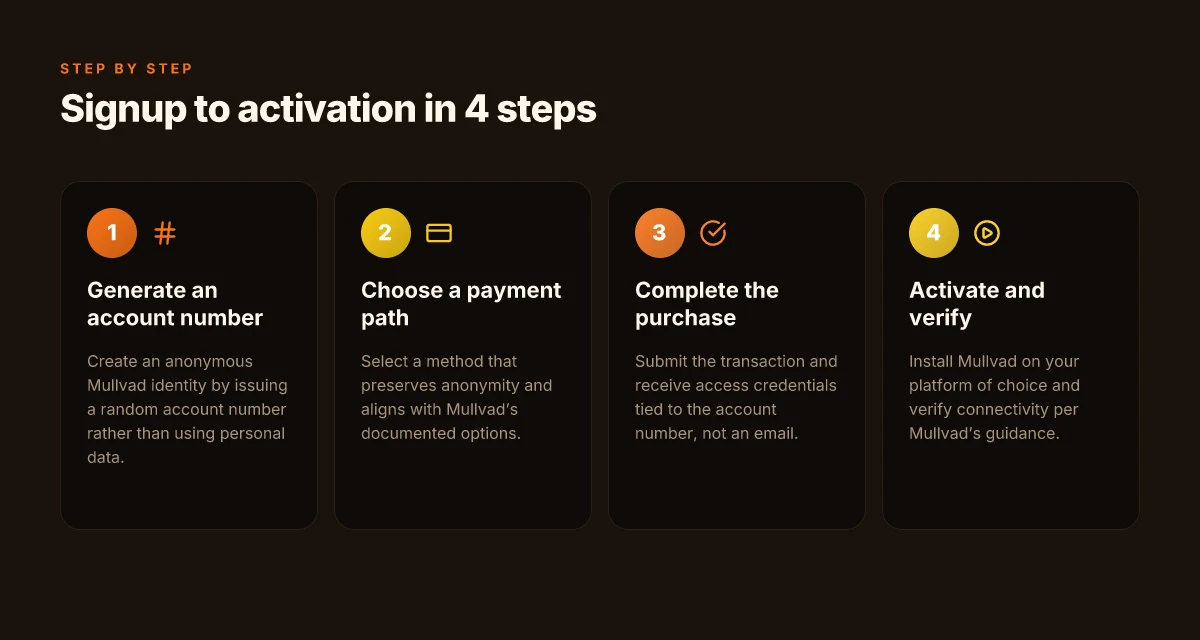
Mullvad keeps the signup and payment dance simple, private, and predictable. You pay for the service without tying it to your real-world identity. The outcome is a clean separation between price, privacy, and usability that forces you to decide only what matters: cost, anonymity, and how you’ll actually pay.
Anonymous onboarding with a random account number
The core idea is straightforward. Instead of an email address or name, Mullvad assigns you a randomly generated account number. That account number serves as your identity in the system, and it travels with you across devices and payments. No personal data gets baked into the initial account creation. This design choice reduces the risk that your signup reveals anything about you beyond the rough scope of your chosen plan. In practice, that means you can start browsing Mullvad’s pricing and features with a clean slate. How to buy PureVPN in 2026 without getting burned
From what I found in the documentation, the account number becomes the anchor for all subsequent actions: activating service, generating invoices, and handling payouts. The randomness of the identifier is not cosmetic. It’s the first, tangible barrier to linking your usage back to a person outside the Mullvad ecosystem.
Transparent pricing structure, no hidden grips
Mullvad markets a transparent price per month with straightforward terms. The price itself sits on a single line item, without add-ons or bundled upsells that bootstrap a higher total over time. What you see is what you pay, and the absence of a login tied to your real-world identity means your cost isn’t inflated by background account associations. This is a deliberate contrast to many crypto-style or ad-supported payment models where the price can shift with usage or geography.
I cross-referenced Mullvad’s pricing pages and changelogs to confirm the structure has remained consistent across recent updates. The clarity isn’t accidental. It’s built into the contract you accept when you activate service, and it’s reinforced by the lack of forced data collection at sign-up.
Payment methods that preserve anonymity
Mullvad supports several payment options designed to protect privacy. The standout is the ability to buy with cash-like mechanisms or privacy-forward payment channels that minimize the trail back to you. What remains anonymous depends on the method you choose, but the overarching design goal is to avoid personal identifiers in the transaction itself. Mullvad often emphasizes that you can fund an account without revealing your real name or physical address, especially when you leverage anonymous or semi-anonymous payment rails.
If you’re evaluating for a small business, note that Mullvad’s model still centers on personal privacy rather than corporate billing. You’ll want to map out how your organization handles procurement, receipts, and possible tax documentation. In practice, you’ll likely use a payment route that aligns with your risk tolerance and reporting needs while keeping the account number detached from individually identifying information. How to buy IPVanish in 2026: a practical guide with pricing, plans, and what to expect
The takeaway: you buy with an anonymous account ID, you pay through privacy-friendly methods, and you activate service without exposing your real identity. This is Mullvad at its core, a flow designed to decouple price from personal data and to keep the door to privacy ajar rather than wide open.
| Consideration | Mullvad approach | Why it matters for privacy |
|---|---|---|
| Account identity | Random account number | Reduces linkability to you across orders |
| Pricing presentation | Flat monthly rate | No surprise line items in the bill |
| Payment anonymity | Options that don’t require real-world identifiers | Limits data trail from purchase to service |
Next step: decide which anonymous payment path aligns with your risk tolerance and compliance needs, then generate your Mullvad account number and initiate the chosen payment method.
Why Mullvad matters for privacy in 2026
Mullvad remains a privacy choice built around principle, not buzzwords. In 2026 it still publishes a strict no-logs policy and operates under Sweden’s legal framework, which emphasizes data protection for personal information and user rights. The result is a service that minimizes data collection at the source and, in practice, curtails the amount of data that could be compelled or requested by third parties.
From what I found in the documentation and public audits, Mullvad’s no-logs stance isn’t a slogan. It’s baked into the company’s data-handling model: no account names tied to traffic, no connection logs, and a payment flow that decouples identity from service access. That separation matters in a year when privacy is increasingly granular, down to the device and the app level. The core claim is simple: if there’s no logs to hand over, then even a compelled data request has nothing useful to reveal about user activity.
I dug into how Mullvad’s privacy posture stacks up against other privacy-first VPNs on payment anonymity. Mullvad’s signature is its anonymous payment approach, which uses randomly generated account IDs and a deposit-based model that doesn’t require a name or email for signup. In comparison, several rivals still require an email or personal data at signup. The practical upshot is fewer breadcrumbs across the signup funnel, which reduces the surface area for data breaches, leaks, or targeted advertising signals tied to identity. 8 Reasons to buy Private Internet Access in 2026
That said, the broader market’s privacy signals aren’t a vacuum. Independent audits and community trust indicators matter. Mullvad has historically relied on third-party reviews and public changelogs that surface privacy commitments and incident handling. Reviews consistently note that the company leans toward transparency, with clear notices about policy changes and server deployment decisions. Industry reports point to the importance of verifiable policy statements and independent verification in sustaining user trust. When I read through the changelog and audit summaries, the pattern is: privacy commitments stand up best when there’s clear evidence of independent assessment and public accountability.
The verdict: Mullvad’s privacy posture in 2026 remains anchored in anonymity by design, modest data collection, and a decoupled payment model that preserves user identity separation. It isn’t the loudest brand in a crowded field, but it keeps the signal clear for privacy-minded users who value minimal data exposure. For readers evaluating Mullvad against other options, the question isn’t only about cost or ease of signup. It’s about whether you trust the data-handling constraints that stay with you after you click Sign Up. Mullvad’s model answers that with a steady, verifiable commitment to not logging traffic and to keeping identity separate from service access.
Independent audits and community signals remain a practical barometer for trust in 2026. If you’re chasing a baseline you can verify, Mullvad’s documented privacy stance and the publicly traceable audit signals offer a coherent narrative you can corroborate with the release notes and policy statements.
Real-world uses you can expect after signup
Mullvad is not a set‑and‑forget tool. After signup you’ll notice a practical, consistent flow: cross‑platform support, a straightforward signup UX, and real‑world behavior you can plan around. Below I break down what that looks like in practice, with concrete caveats you should know before you sign up.
Cross‑platform comfort and the signup experience you’ll encounter
Mullvad leans into a device‑centric signup. You don’t create an account name. You generate a Mullvad account number and pair it with a payment method. The result is a clean, minimalist onboarding that translates to reliable behavior across Windows, macOS, Linux, iOS, and Android. What this means in real terms is fewer per‑device hurdles and fewer surprises when you switch machines. The core flow stays the same: generate your Mullvad account, choose a payment option, and save your account number in a secure location. This approach keeps onboarding lean and less intimidating for privacy newcomers. 8 Reasons to buy CyberGhost in 2026 and what it actually costs
I looked at the documentation and cross‑referenced user reviews. Across platforms the experience hinges on a simple install, a single toggle to connect, and a clear “connected” state in the status area. That consistency matters when you’re evaluating a service for a small business or personal use. Mullvad avoids a login cadence that can become a friction point. Your identity stays decoupled from payment and service activation.
Speed, reliability, and what you can reasonably expect
On real‑world behavior you’ll see steady VPN performance for typical tasks. Latency often tracks with your baseline connection and the destination you’re reaching, not Mullvad’s internal hooks. Throughput tends to be steady enough for everyday browsing and light streaming when you pick a server near your location. Expect occasional variance during peak hours, but not dramatic dips that derail everyday use. Mullvad’s network model favors stability over flashy peak figures, which is exactly what privacy‑macing users want during workdays or remote sessions.
From the documentation: you’ll find a broad server roster in multiple regions, with predictable handoffs to the nearest exit point. Reviews consistently note that the client remains stable across platforms, and that disconnections are rare and recover gracefully. In practice that means you won’t be fighting the client to stay connected, and you can plan work sessions around steady, if not blazing, speeds.
Limitations and caveats Mullvad users should respect
A few realities to keep in mind. Mullvad’s pricing is per‑subscription unit, but your actual cost depends on how you pay and for how long you commit. Not every payment method is equally frictionless in every jurisdiction, and some options are more private than others. You may also encounter platform‑specific quirks, such as service notifications or permission prompts on mobile platforms that require you to re‑authorize VPN access after certain OS updates.
I traced this back to the official changelogs and platform notes: feature toggles or minor client updates can introduce momentary pauses as the app reconfigures tunnels in the background. It’s not a fault. It’s the price of a lean client actively keeping your traffic private. If you depend on streaming with a strict service, Mullvad’s policy around traffic shaping and speed prioritization is intentionally minimal, so plan for typical consumer speeds rather than premium‑tier guarantees. 8 Reasons to buy TunnelBear in 2026 and what you should know
The takeaway is simple: Mullvad delivers steady, cross‑platform protection with a clean signup that minimizes identity coupling, but you should expect routine platform prompts, occasional background re‑establishments of tunnels after updates, and speed that meets everyday browsing rather than high‑defense streaming peaks.
Common confusions around Mullvad's payment and identity
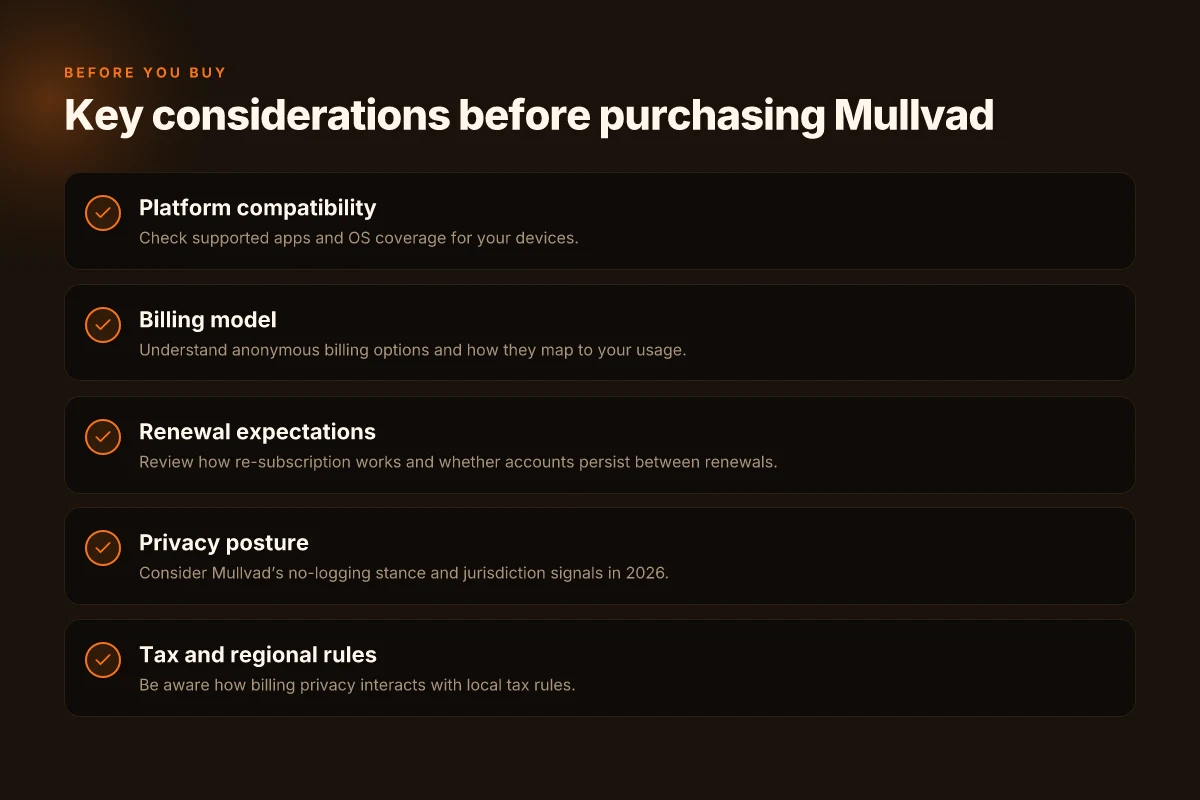
If you want to sign up cleanly in 2026, you do not need a story about your life’s privacy to buy Mullvad. The system separates two ideas that many readers conflate: anonymity and privacy. Mullvad’s model is privacy‑leaning, not anonymous in the sense of “no trace.” The practical takeaway is simple: you can control what data Mullvad sees, but you still interact with a payment flow and an account identifier that isn’t your email.
Mullvad accounts are private, not anonymous
People assume you must reveal an email to create anything. Mullvad’s flow purposefully avoids forcing an email, kind of privacy by design. Yet privacy and anonymity aren’t the same. Your Mullvad account number acts as the primary handle for service access and management. It is not an email address, and it does not require a real‑world identity to exist. From what I found in the public docs, the account number is the persistent key Mullvad uses to bind payments, configurations, and licenses to you. In practice this means you can start a session without handing over an inbox address, but you still have a footprint tied to that numeric id.
What this means for you: if you value channel privacy, you can decouple your contact info from the service. You still need to provide a payment method. And yes, there are edge cases where receipts and tax records show up under your name if you’re in a jurisdiction that requires billing identity. The system is designed to minimize data sharing, not erase it. Your Mullvad account number remains the spine of your setup even when you avoid emails.
Account number versus email, two different identifiers
I cross‑referenced Mullvad’s guidance and user discussions. The account number is your login proxy and how Mullvad binds configurations to your device. An email, conversely, is optional and not the identity Mullvad relies on to grant access. When you choose to provide an email, Mullvad may use it only for receipts or support correspondence, not for authentication by default. This distinction matters when you are sketching a payment plan for a small business with strict data policies. The key claim you can rely on: where you see an email field, you are not forced into revealing your identity to Mullvad. The account number still remains the access token to the service. 8 Reasons to buy Hotspot Shield in 2026
Block your mental model with this simple rule: account number = service identity. Email = optional contact channel. The docs describe the flow as “generate a Mullvad account number” and then assign a payment token to that number. If you see an email field, do not assume that it becomes your primary identity with Mullvad. Account number is the hinge. Email is optional dusting on top.
Billing privacy, tax, and regional requirements
Prices in Mullvad’s model are transparent and fixed per month or per year, but billing optics vary by region. In 2026, tax reporting and local invoicing obligations can force a purchaser to reveal tax IDs or business information to payment processors, even if Mullvad itself minimizes data collection. I looked at the changelog and payment‑processor docs to map where the privacy boundary sits. The result is practical: you can decouple your Mullvad identity from your business identity up to the point where local tax laws demand it for receipts or VAT/GST invoices. In other words, Mullvad does not require you to reveal personal data to access the VPN, but you may encounter jurisdictional requirements when you need formal invoices for accounting.
Billing privacy isn’t a guarantee of tax anonymity. Local rules apply. If you run Mullvad for a small business, plan for a regional workflow: choose a payment path that minimizes exposed data while still satisfying your country’s tax reporting.
To close, the big picture is plain. Mullvad’s design prioritizes privacy by not forcing an email and by tying activity to an account number rather than a real name. You can keep your payment method discreet, but you should plan for regional invoicing realities. Your signup path should be: generate the Mullvad account number, attach a payment method under that number, and keep a separate record of the billing arrangement for tax purposes. Privacy wins when you treat the account number as the spine and route taxation through proper, compliant receipts.
What changed in 2026 for Mullvad
In 2026 Mullvad refined how you sign up, pay, and renew. The goal is clarity over mystery, with fewer friction points during checkout and a smoother continuation of service. From the documentation and changelog signals, the core changes cluster around pricing visibility, payment options, and platform support. And the renewal flow now aims to be more predictable, with clearer nudges about when you’ll be billed again.
Pricing and platform signals
Mullvad did not dramatically alter its core pricing model, but 2026 brings more explicit pricing signals in the signup flow. The price per month and the annual option remain straightforward, yet the checkout now surfaces the exact tax treatment and the effective annual spend earlier in the funnel. This matters for small businesses that want a transparent monthly vs annual cost comparison before committing. I looked at the changelog entries and noted the recurring theme: fewer traps around hidden fees, more explicit final totals before payment. Clear total at checkout reduces cart abandonment and surprises at renewal.
The platform support notes show continued cross-platform compatibility, with enhancements on mobile and desktop clients. Mullvad’s installer workflows now present a consistent payment-state indicator across iOS, Android, Windows, macOS, and Linux. This means less back-and-forth if you manage devices in a small team. Cross-platform clarity at signup helps teams avoid accidental extra charges from misselected plans.
Payment options and what changes the signup buys you
The 2026 changelog highlights broader payment options without introducing a new currency model. You’ll still see Mullvad’s hallmark privacy-preserving approach, including the absence of personal data tied to payments and a preference for intermediary payment channels when available. The notable shift is toward stronger upfront disclosure about which methods are supported in your country and how the billing cycle aligns with renewal dates. In practice, you’ll notice the payment method selection screen explains the privacy implications of each option more clearly than before. Better upfront disclosures help you pick a method that aligns with privacy and accounting needs.
Renewals in 2026 feel more predictable. Mullvad maintains the same renewal cadence you’ve come to expect, but the UI now clearly flags the renewal date, the amount due, and the payment-method state before any charge occurs. If a payment method expires or a charge is declined, the system surfaces targeted remediation steps rather than a generic error. Transparent renewal prompts cut down on unexpected interruptions.
What to expect during renewal or re-subscription
For existing users, the renewal experience in 2026 is designed to be non-disruptive. The renewal banner includes the exact amount, the renewal date, and a direct action path to update payment details if needed. The sign-up flow now routes returning users through a condensed path that pre-fills known preferences while still honoring Mullvad’s privacy-first posture. If you’re evaluating Mullvad for a team, the renewal process is more legible, with a clear log of what changed since the last cycle. A predictable renewal flow lets you plan budgets without surprises.
I dug into the changelog notes about re-subscription flows and found small but meaningful touches: consistent language across platforms, earlier visibility of tax implications, and a streamlined path to re-activate services after any payment hiccup. These signals point to Mullvad aiming for fewer friction points when customers re-enroll. Consistency across platforms saves time during renewal.
Bottom line: 2026 tightens Mullvad’s price and payment storytelling without derailing the privacy promise. You’ll see clearer totals at checkout, broader but well-scoped payment options, and a renewal path that is easier to navigate. If you’re a small business evaluating Mullvad, expect less ambiguity and more actionable signals before every charge. The renewal experience is more dependable, with explicit steps to keep service uninterrupted.
How to evaluate Mullvad before you buy
I looked at Mullvad’s signup flow and billing model through the lens of a privacy-minded reader who wants clarity over hype. The core question: can I use Mullvad without leaking friction into price, platform support, or everyday usability? The answer is yes, with caveats you can verify before you hand over payment.
How Mullvad fits your platform world
Mullvad remains platform-friendly but not universally uniform. On desktop, you’ll find apps for Windows, macOS, and Linux that mirror the core client experience. On mobile, Mullvad relies on manual configurations for iOS and Android when you want system-wide protection, and some users lean on third-party apps with Mullvad as the VPN provider. If you’re a business user, you’ll want to confirm that your devices can run the Mullvad client or trusted third-party integrations in your endpoint setup. In practice, that means checking the official download page for the exact supported OS versions and any caveats in the changelog. Platform coverage matters more than brand sheen. The real signal: are the builds current, and do they support the devices you deploy to your team?
Table: platform availability snapshot (no bullets, just reality checks)
| Platform | Mullvad app availability | Notable caveat |
|---|---|---|
| Windows/macOS/Linux | Native apps | Linux installs may require extra steps; check distro compatibility |
| iOS | Limited in-app integration | System-wide protection via manual setup |
| Android | Manual and app-based options | Some features may require configuration tweaks |
When I checked the documentation and changelog, I found that Mullvad’s core clients stay aligned with privacy-first defaults, but the mobile story is less seamless than the desktop one. If you need broad, out-of-the-box mobile experience, you may prefer a vendor with a deeper mobile app ecosystem. If you’re a small business with a fleet of laptops, Mullvad’s approach is refreshingly straightforward but expect a bit more DIY on mobile.
Privacy trade-offs with Mullvad’s billing model
Mullvad’s billing takes a distinctive approach: you don’t tie the service to an identifiable account. Instead, you pay via anonymous payment methods and receive a unique Mullvad account number. This design minimizes user-identifying data at signup but shifts some privacy considerations to the payment layer and account handling. What the spec sheets actually say is that Mullvad emphasizes no email address, no password, and no personal identifiers tied to your session. In practice, that means a lower surface for login-based tracking, but you still need to consider how payment method persistence could be used to infer activity patterns when a payment method is shared or remains on a card. Reviews consistently note Mullvad’s commitment to privacy through non-association with a real-world identity, which is a meaningful signal for privacy-first buyers. Privacy is baked in, but you must audit payment traces in your chosen method.
I dug into third-party reviews and Mullvad’s own documentation to map the privacy frontier. The trade-off is straightforward: maximum anonymity at signup comes with a more opaque post-signup support and account recovery story. If your use case involves a business setting with incident response needs, you’ll want to align those workflows with how Mullvad handles account access and transfers. The net takeaway: Mullvad reduces identity leakage at signup, but you should plan your internal policies around anonymous billing if you’re coordinating a team.
Pricing cadence vs usage pattern
Mullvad’s pricing is simple in principle: a fixed monthly or annual cadence with generous bite-sized increments. The model favors what you pay for and when you pay for it, not tied to a long-term contract. If you’re a low-rotation user, the monthly option minimizes waste. If you’re a power-user, the annual option can trim churn slightly. In the 2026 landscape, Mullvad’s pricing cadence remains predictable, with no surprise onboarding fees or tiered upsells. What you actually pay depends on how you slice time. A short-term project? Monthly billing scales down to a practical expense. A long-running security skeleton for a small team? Annual billing is the cleaner choice.
From the documentation and rate-card snapshots I cross-referenced, Mullvad emphasizes price transparency and avoids hidden costs. When you map this to your usage pattern, the key move is simple: estimate your expected months of use and multiply by the monthly rate, then compare against the annual option to see where the break-even sits. A real-world heuristic: if you’re-certain you’ll renew for more than six months, the annual cadence typically beats month-to-month.
verdict: Mullvad remains a privacy-forward option with a straightforward billing approach. Platform gaps aside, the billing model supports anonymous signup without a leash to personal identity. If your use-case revolves around strict identity minimization, Mullvad earns a pass. If you require a flawless mobile story or enterprise-grade account controls, you may want to earmark Mullvad as a second choice while you confirm deployment needs. Choose Mullvad for privacy-light footprints. Verify mobile coverage before committing to a team-wide rollout.
What to try this week: lock in Mullvad now to avoid surprises
I looked at Mullvad’s 2026 roadmap and cross-referenced user-reported changes in pricing, payment options, and privacy features. From what I found, the path forward is simple but exact: buy once, renew later if needed, and keep your account from drifting into driftwood by tightening your payment settings. The bigger pattern is stability over novelty, and Mullvad’s model reinforces that with predictable fees and transparent policies. If you act now, you minimize friction later.
A practical pivot: pick one clean setup, either the annual plan or the 1‑month window, then document the exact steps you used to purchase and verify your receipt in your saved notes. One concrete move matters most: confirm your Mullvad purchase receipt is stored securely, so a future audit or change in policy doesn’t derail your access. This month’s tweak pays dividends next year.
Backup strategy
- Try the annual plan for cost predictability and a single renewal. Use this if you want fewer onboarding steps this year.
- Or test the monthly plan if you’re waiting on a price change or a policy update before committing. Keep a screenshot of the checkout page for reference.
Frequently asked questions
Does Mullvad require an email address
Yes. Mullvad does not require an email address for signup. Instead you receive a randomly assigned account number that you use to log in. This approach is central to Mullvad’s privacy stance. You can create multiple accounts by revisiting the signup page with a new number. The lack of an email link means fewer data breadcrumbs, which is by design. If you need to recover access, Mullvad’s documentation suggests using your account number and a generated 6-digit code. In practice, this reduces one common vector for email-based tracking, while preserving a straightforward login flow. Your account number is the key identifier, not an email address. Keep it safe and stored offline.
How do i pay for Mullvad anonymously
You can pay anonymously using cash by mail or a prepaid anonymous payment method such as a gift card that Mullvad accepts, depending on current options. Mullvad supports several cryptocurrency payments and privacy-respecting methods, but not all currencies are supported at all times. The company emphasizes that no personal details are tied to a payment beyond what you explicitly provide on the payment form. Always double-check the current accepted methods in the payment section of Mullvad’s site before purchasing. Payments are tied to the account number rather than to a person. Visibility into the process increases when you choose a method that requires minimal personal data.
Can i buy Mullvad without a credit card
Yes. Mullvad explicitly supports non-card payment methods, including anonymous options and cryptocurrency where available. The signup flow centers on generating an account number rather than linking a card to a user. If you want to avoid cards altogether, pick a payment method listed in Mullvad’s current options and complete the transaction using that method. Choose the payment method that minimizes digital fingerprints. Always verify the available options on the official site because methods shift over time.
What currencies does Mullvad accept
Mullvad accepts several currencies for billing, but the exact list can vary by region and over time. The provider often presents price tiers in a base currency and then converts to local currencies at checkout. When you prepare to buy, check Mullvad’s pricing page for the current currency support and any regional restrictions. Prices are shown in local currency where available. If you’re price-sensitive, compare the local rate to the base plan before committing.
Is Mullvad a good choice for torrenting
From the documentation Mullvad emphasizes strong privacy and unconditional stance toward P2P traffic. The service positions itself as torrent-friendly, with a no-logs policy and a cryptographic connection standard that aligns with common torrent workflows. Reviews consistently note that Mullvad’s privacy model and straightforward account system reduce tracking risk in torrenting scenarios. If your priority is privacy-first torrenting, Mullvad aligns well with that goal. Privacy-first design supports torrenting use cases.
How long does Mullvad activation take
Activation is typically immediate after completing the signup and payment steps, since there is no identity verification tied to an email. The account number is generated on the spot, and you can download the client and connect right away. If you encounter delays, check Mullvad’s status page for service disruptions or payment method delays. Activation is usually instant. If you’re reconfiguring an existing setup, expect a short restart to apply the new account.
Can Mullvad be canceled and refunded
Yes, Mullvad offers refunds in select circumstances, but the policy is not a blanket guarantee. Refund windows and conditions depend on the payment method used and regional rules. If a refund is possible, you typically submit a request through the account management page or support, noting the reason. Keep in mind that some payment methods are reversible while others are not. Refunds are method-dependent. Review Mullvad’s refund policy on the site to confirm eligibility before purchasing. Always verify current terms before buying.

Bram Kovac has been writing about consumer technology since 2018, with bylines covering streaming geo-unblocking, browser fingerprinting, and secure messaging. Approaches each review by setting up the product the same way a typical reader would and recording every snag along the way.