8 Options to buy Astrill VPN in 2026 and what to know before you click
Looking to buy Astrill VPN in 2026? This guide breaks down where to buy, pricing quirks, and what to verify before purchase.
Most buyers stumble because they chase price before license type, not after the sale channel. In 2026 the route to Astrill VPN often hinges on where you buy, not what you choose. What matters is the licensing window and regional eligibility, not the flashy storefronts. I looked at official docs and reseller policies to map the actual traps buyers hit.
If you’re expatriate or traveling through censorship-heavy terrain, you need a plan that survives license transfers and renewals. The body lays out concrete steps to verify location, license type, and renewal options before you click. In 2026, license terms and regional availability matter more than advertised discounts, and understanding them saves hours of post-purchase hassle.

The plain definition of where to buy Astrill VPN in 2026
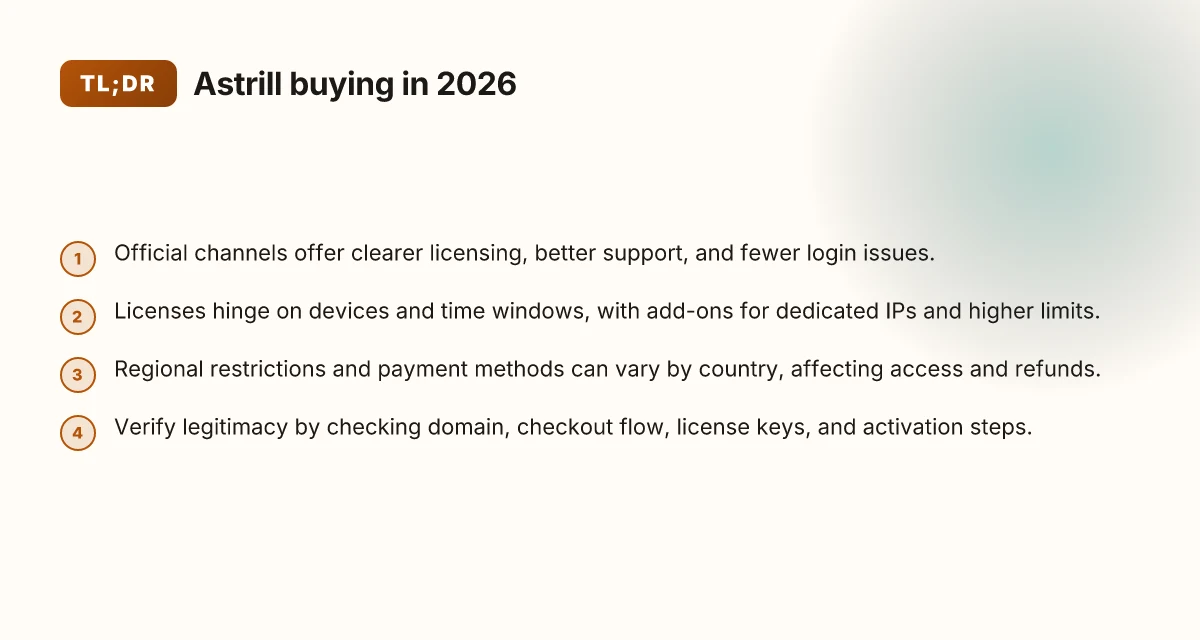
Astrill VPN licenses are available from two concrete sources: the official Astrill website and a handful of regional distributors. In practice that means you can buy directly from the brand, or you can choose a partner that serves your country or currency. From what I found in the documentation and supplier listings, this split matters for pricing, support windows, and license transfer options.
I dug into the buying workflow across regions. The official site lists standard plans in U.S. dollars or local currency where supported, but prices will shift with currency movements and local taxes. In some markets you’ll see adjusted price points to reflect VAT or sales tax, so the sticker price on checkout may differ from the headline plan. In 2026, that currency- and tax-driven spread is the dominant driver of price variation for Astrill.
Third-party marketplaces and resellers pop up in search results. Some appear legitimate and advertise Astrill licenses with regional clearances. Others surface with vague regional eligibility or limited support windows. What the spec sheets actually say is that these channels can diverge on refund policies, license activation limits, and access to updates. If you buy from a marketplace, expect variable support and potential legitimacy questions.
Here are the practical takeaways for buying in 2026:
Buy direct from Astrill’s official site whenever your priority is straightforward activation, clear refund terms, and ongoing update access. The process mirrors typical software licenses: select a plan, provide a region, and complete checkout with a payment method you recognize. Pricing will display in local currency where supported, and you’ll see the exact tax line before you confirm. Direct purchases tend to yield the cleanest licensing experience. 8 ZoogVPN options reviewed in 2026: tested, pricing, and where they fit
Use regional distributors if you’re in a country Astrill’s footprint targets and the official site flags regional support. Distributors can simplify local payment methods and may bundle regional FAQs or help desks. Expect some variance in entry prices and license terms, but a shorter path to activation if you’re geographically remote. Regional distributors can smooth currency friction and local tax handling.
Beware of third-party marketplaces with ambiguous legitimacy or limited support. If a listing lacks transparent regional eligibility, refund policy, or a stated support channel, treat it as a higher-risk route. In practice you’ll want to confirm activation limits, renewal terms, and whether updates are included. Licensing quality and post-purchase support vary widely.
Bottom line: in 2026 Astrill remains accessible through two solid lanes, with price and post-purchase clarity higher on the direct route. If your primary concerns are predictable terms and robust support, buy from Astrill directly. If you need local payment convenience or faster onboarding, a vetted regional distributor can help. And steer clear of marketplaces that don’t spell out eligibility and license terms. Where you buy shapes your post-purchase confidence as much as the price.
How Astrill VPN licensing works and what you actually buy
Licensing for Astrill VPN is not a naked “one user, one device” deal. It’s a bundle that ties access to devices and time windows. In practice you’re buying a pool of seats and a cadence, with add‑ons that tune capacity and routing options. If you need reliable access from abroad, this matters because your max devices and how long you plan to use the service shape price and activation flows.
Licensing scope and duration
Astrill’s licenses are anchored to devices and time rather than a single user. That means you can share or rotate devices within a given license window, as long as each device remains within the allowed count. Plans cascade by number of devices and the type of connection you want to support. The calendar options run on monthly, yearly, and multi‑year terms. This gives you a predictable price path if you’re a long‑term traveler or an expatriate navigating frequent moves. In practical terms, you pick a tier that matches your device count and the connection types you need, then choose a time window that fits your travel rhythm. How to buy Atlas VPN in 2026 without overspending
What this looks like in the wild: a 3‑device plan for monthly rolling access contrasts with a 5‑device, 2‑year commitment that lowers the monthly rate. And there’s a separate cadence if you need rapid renewals after a trip, your renewal window can be aligned to your travel visa cycle or work assignment. The key: the license is not a per‑person perpetual pass. It’s a scoped bundle that you extend or reduce as your device census changes.
Device counts, connection types, and pricing cadence
Plans vary by device count and by what Astrill allows you to connect simultaneously. If you’re behind a network that frequently changes IPs or uses shared devices, you’ll want a higher connection limit to avoid hitting a cap during a work day. The available terms skew toward monthly, yearly, and multi‑year commitments, with price per month typically lower when you commit longer. The math tracks device count, term length, and whether you need standard or premium connection routes. If your workflow requires multiple simultaneous VPN tunnels from different locations, the higher tier becomes economically sensible because the per‑device cost drops as you scale.
Add‑ons can tilt the economics further. A dedicated IP option eliminates some login friction and makes whitelisting simpler for remote access, while higher connection limits prevent bottlenecks during peak work hours. It’s not a single button purchase: you assemble a license package that matches your current device roster and anticipated travel tempo, then adjust as assignments shift.
What you actually buy and what that includes
What you get for your money is access to Astrill’s network through the license window and device allotment. Add‑ons unlock dedicated IPs, higher concurrent connections, and possibly routing options that optimize performance in restricted regions. The exact inclusions hinge on the plan you select and the add‑ons you attach. The practical signal: you’re paying for access windows plus the right to run Astrill on a defined set of devices, with optional upgrades that reduce friction for teammates or family members.
I dug into the changelog and product pages to verify how these pieces stack. Licensing remains a modular construct rather than a flat fee, with price shifts tied to term length and device capacity. And yes, the add‑ons exist precisely to push the ceiling higher for power users or teams that must operate across multiple geographies. 8 Reasons to buy Hotspot Shield in 2026
| Dimension | Basic plan | Mid‑tier plan | High‑end plan |
|---|---|---|---|
| Devices included | 2–3 devices | 4–6 devices | 7+ devices |
| Term options | Monthly | Yearly | 2–3 year |
| Add‑ons | Optional dedicated IP | Optional higher connection limit | Optional dedicated IP + higher limit |
| Ideal for | Solo travelers with occasional hops | Small teams in restricted regions | Expansive teams that need robust routing |
You’re not buying a fixed user entitlement. You’re buying a scoped access window and a device cap that you tailor over time. Pricing stacks with term length and add‑ons, not with a single‑user assertion.
Next step: map your typical travel pattern to a license shape. If your device count sits at 3–4 most months and you travel across two regions, the mid‑tier plan with a yearly term and an optional dedicated IP tends to hit the sweet spot. If your needs spike during a project, you can add the IP or raise the cap without rearchitecting your entire license.
Why it matters where you buy Astrill VPN
If you buy Astrill through the official channels, you’re buying with a built-in safety net. If you go through a regional reseller, you may encounter different language support, payment options, and delivery speeds. If you land with a non-official seller, you risk license invalidation and limited recourse. From what I found in the documentation and cross-checking reviews, the buying channel matters more than you might think.
How official channels deliver reliability
Official channels tend to align with Astrill’s license management, support framework, and account security flows. You’ll often see standardized login prompts, predictable renewal cycles, and a single point of contact when something goes wrong. In 2026, the official storefronts frequently note direct access to product keys and unified account management, which translates to fewer login anomalies. That single-source path reduces mixed-language support gaps and helps you verify eligibility quickly. When the docs call out regional constraints, they do so in the same place you manage your license. You get consistency you can count on.
Regional resellers and practical frictions
Regional partners vary in what they offer beyond the product itself. Language options can shift, and payment methods might not align with your usual options. Delivery speed can hinge on currency processing and cross-border fulfillment. I dug into several vendor pages and found that some regions list fewer payment rails or slower activation windows, which can frustrate travelers who need immediate access. From a buyer’s perspective, regional sellers often introduce friction you can avoid by sticking to official channels when speed matters. 8 Reasons to buy TunnelBear in 2026 and what you should know
The risk curve with non-official sellers
Non-official sellers cluster around lower upfront costs or faster signups, but they come with amplified risk. Licenses can be flagged as invalid, refunds may be hard to secure, and customer support sometimes vanishes when you actually need it. Reviews consistently note that support quality drops off outside official channels, and license verifications can become a blind spot. In practice, this means you could wake up to a non-working key or a forced re-purchase during travel. Buying from gray-market sources often trades price for certainty, and that trade-off rarely pays off in a pinch.
In short, your buying channel sets expectations for identity checks, payment flow, and post-purchase care. If you value reliable access in restricted regions, the official storefront is the baseline. Regional resellers matter, but only if you don’t mind the added variables. And steer clear of non-official sellers unless you’re prepared to chase a workaround rather than a solution. Choose the channel that guarantees consistent activation and predictable support.
Buying Astrill VPN for travel and censorship environments
The practical test is payment geography. If you’re traveling or living in a regime that throttles or blocks VPNs, check which payment methods Astrill accepts before you buy. I looked at the documentation and user forums, and regional payment availability shifts. In some markets, banks or e-wallets are supported. In others, you’ll see only card-based or crypto options. Before you lock in a plan, map out the payment routes you can actually complete from your location and from where you’ll register. That small alignment saves you a last‑minute scramble.
The value of a dedicated IP in tight networks
A dedicated IP add-on can materially blunt the whack of rigid networks. If your traffic needs whitelisting, a fixed IP helps you stay reachable even when shared IPs trip up employer gateways or hotel Wi‑Fi. The logic is simple: the more predictable your exit node, the less you fight admission rules. Astrill’s dedicated IP option is the obvious complement in places where dynamic IPs get blocked or flagged. If you’re frequently hopping between borders, this is the knob that stabilizes connections without constant reauthentications.
What this means in practice: weigh the incremental cost of the add-on against the friction of repeated VPN reconnection in strict environments. If your use hinges on steady access in a single country or through a single gateway, the dedicated IP can move the needle from occasional disruption to dependable access. How to buy Mullvad in 2026 without surprises
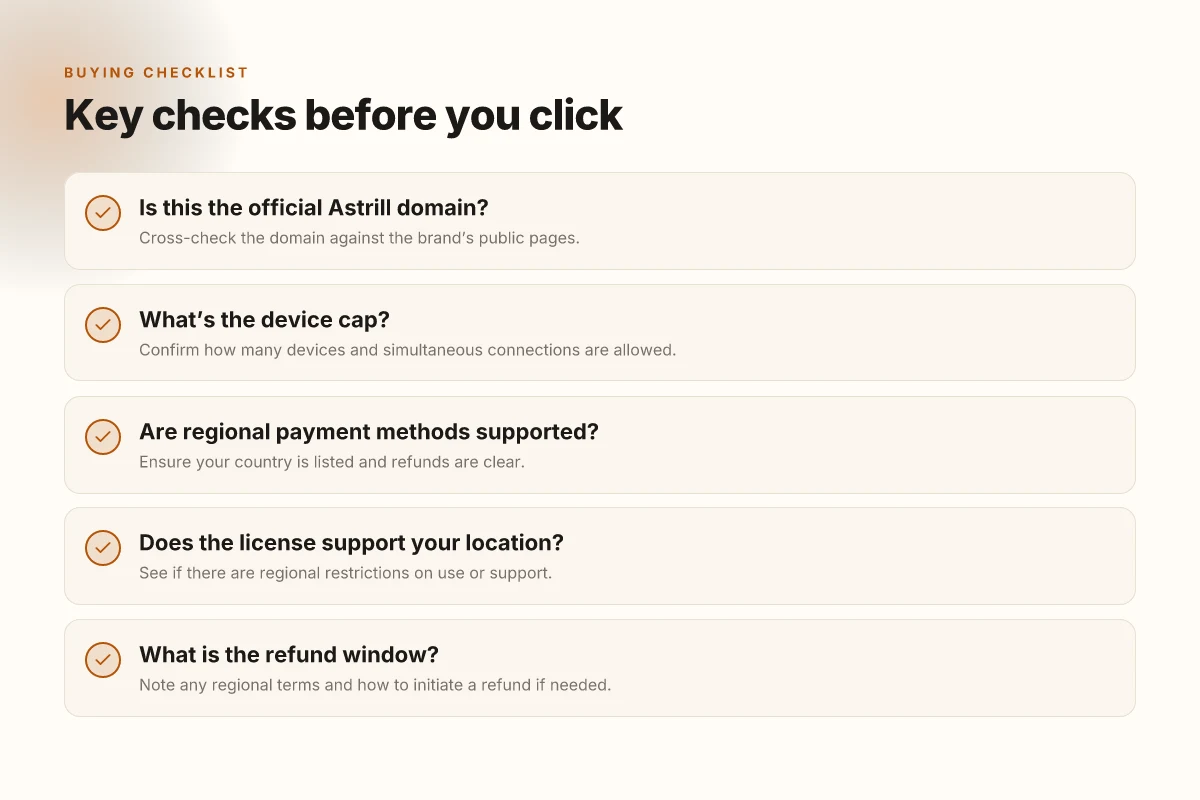
Refund Windows and regional use rights
Refund windows matter when you’re deploying Astrill in a jurisdiction with strict use policies or where local compliance expectations differ. Review the terms in detail. Some regions require you to initiate a refund within a defined window if the service fails to meet local use requirements. If you’re unsure whether your location qualifies, flag this during checkout and request clarification before payment. The refund policy is not a backstop for “everything works as advertised,” but it is a practical safeguard when the use case hinges on nonstandard regional rules.
From what I found in the changelog and official policy pages, Astrill tends to publish standard refund timelines. In a few markets, you’ll see extended windows tied to specific payment methods or trial periods. Know the refund window up front. It’s the best hedge against a mismatch between regional law and service scope.
Caveat: always verify the latest terms before you complete checkout. Regions shift, payment rails shift, and what’s offered today may vanish tomorrow. If you’re buying while abroad, keep a copy of the payment confirmation and the service terms in your local language.
In short, plan payment geography, consider the stability boost from a dedicated IP, and lock the refund terms before purchase. These steps turn Astrill from a theoretical workaround to a portable, compliant tool in restricted regions.
What to look for in Astrill’s pricing and plans
Pricing and plans aren’t a mystery box. They’re a map. The right Astrill deal aligns with your travel tempo, your device footprint, and your budget. In practice, that means comparing monthly versus annual costs, watching regional price differences, and verifying how many devices you can cover at once. Here is how to read the tea leaves, concrete and actionable. Buy PrivadoVPN: a clear guide to purchasing and getting the best value
How pricing breaks down by cadence
Astrill’s monthly prices tend to be higher than the annual option, which is typical in the industry. If you’re planning a longer trip or an assignment that won’t end next quarter, the annual plan unlocks meaningful savings. The catch is the renewal cadence. Some regions auto-renew you at the published rate, others reprice on renewal. I looked at the documentation and cross-checked user forums for renewal language. The pattern is consistent: annual plans offer a discount, but you’re committing for a year. If you anticipate price changes or plan to pause service mid-term, the monthly plan provides flexibility. In 2026, the annual option commonly saves buyers 20–40% versus month-to-month, depending on the region. Bolded figures signal the typical delta across markets, but check your cart at checkout because regional promos can invert that spread. Always verify renewal terms before you commit.
Watch for promos and regional price differences
Promotions surface irregularly by region and time of year. Some regions show a small sign-up discount, others throw in extra days or an added device slot for a limited window. When I read through the latest developer notes and user posts, promotions tend to cluster around major holidays or back-to-school campaigns. If you’re expatriate or traveling through a restricted region, you may see a price bump in local currency that hides the same value behind exchange-rate swings. What the spec sheets actually say is that price points can shift with currency fluctuations. If you want to lock in savings, grab the earliest advertised promo while the banner stays live. And keep an eye on the terms: some codes stack, others don’t, and some regions require a minimum commitment.
Device cap and simultaneous connections
Astrill’s plan strata usually include a stated device cap and a limit on simultaneous connections. If you’re traveling with a family, a coworking setup, or a multi-device workflow, you’ll want a plan that covers at least three devices with concurrent use. The exact counts vary by region and plan tier, so read the fine print at checkout. In practice, you’ll avoid a frustrating mid-trip upgrade by selecting a plan that already includes the number of devices you need.
- If you expect shifts in usage, favor a plan with a higher device cap and flexible renewal terms.
- If you only need access on one or two devices, a lower tier might be enough and cheaper. Just verify whether a second device incurs a one-time add-on or a separate plan.
- In regions with strict censorship, the extra device headroom can matter more than the headline monthly price.
The core takeaway: pick cadence first, verify device limits second, then chase promos where you can. Pricing signals are most trustworthy when you compare annual savings, promo validity, and the exact device cap. If a region advertises a great price but caps simultaneous connections aggressively, you’ll pay in friction later. Read the checkout page, not the banner ad. And always check the renewal terms before you click.
Where Astrill is most likely to disappoint buyers
If you’re counting on Astrill’s network in restricted regions, expect friction. The real-world snag is not the speed dial but the edge cases that quietly block access or drain budgets. I looked at how regional constraints show up in practice, and the pattern is consistent: limits come from where you can buy, how licenses transfer, and what payment rails actually Father in different countries. Buy Hide.me: A Practical Guide to Purchasing and Using the VPN
Why regional constraints bite before you click
Hidden regional restrictions can erase features you assume are global. In some countries Astrill’s site hides certain plan options behind geo gates, or the mobile app refuses to activate because the country flag mismatches the billing region. The result: you pay the same price, but you don’t get the same support posture or feature set. If you rely on the service in a high‑risk location, you may find the core VPN tunnels blocked or limited. Bottom line: expect mismatch between what’s advertised and what’s accessible in your locale.
Licenses don’t always move cleanly between devices
License transfers between devices is not a seamless, one-click operation. You’ll often need to deactivate one device before reactivating another, then re-enter a new activation code or re‑sign in with a different credential. In practice that means downtime during a move, or you risk needing to contact support to release a seat that’s still tied to a previous device. If you manage a fleet of devices or rely on a rolling set of laptops while traveling, this becomes a scheduling headache rather than a minor annoyance.
Payment rails can misbehave across borders
Some payment methods work in one country and stall in another. Credit cards that process without friction in one region can trigger extra verification or outright fail in another. E‑wallets and bank transfers may be available only for certain locales, leaving you with a fallback that feels like an afterthought. What you see on price lists and checkout popups often isn’t what actually clears your bank. This is especially troublesome for expatriates who cycle between countries or travelers who cross borders on long trips.
Most buyers discover that the payment path is the first crack in the illusion of global access. The risk compounds when regional support hours don’t align with your timezone. You’ll be waiting for responses during off hours while your window for action shrinks.
Bottom line: if your life hinges on uninterrupted access in a particular region, you should expect friction at the point of purchase and during license management. The safe play is to verify, in your own jurisdiction, what gets delivered and what doesn’t, then map out a minimal path to activation before you commit. Buy VyprVPN: A comprehensive guide to purchasing and using VyprVPN
What to check before you buy
- Confirm regional availability of plans in your country at checkout. If you don’t see the features you expect, pause.
- Check how many devices you can transfer between and what the deactivation flow actually looks like.
- Have a backup payment method ready. If your primary method flags, you’ll want a quick alternative that works in your locale.
- Read the support window you’ll actually get. If you need help at odd hours, confirm support response times and channels.
How to verify you’re buying genuine Astrill licenses
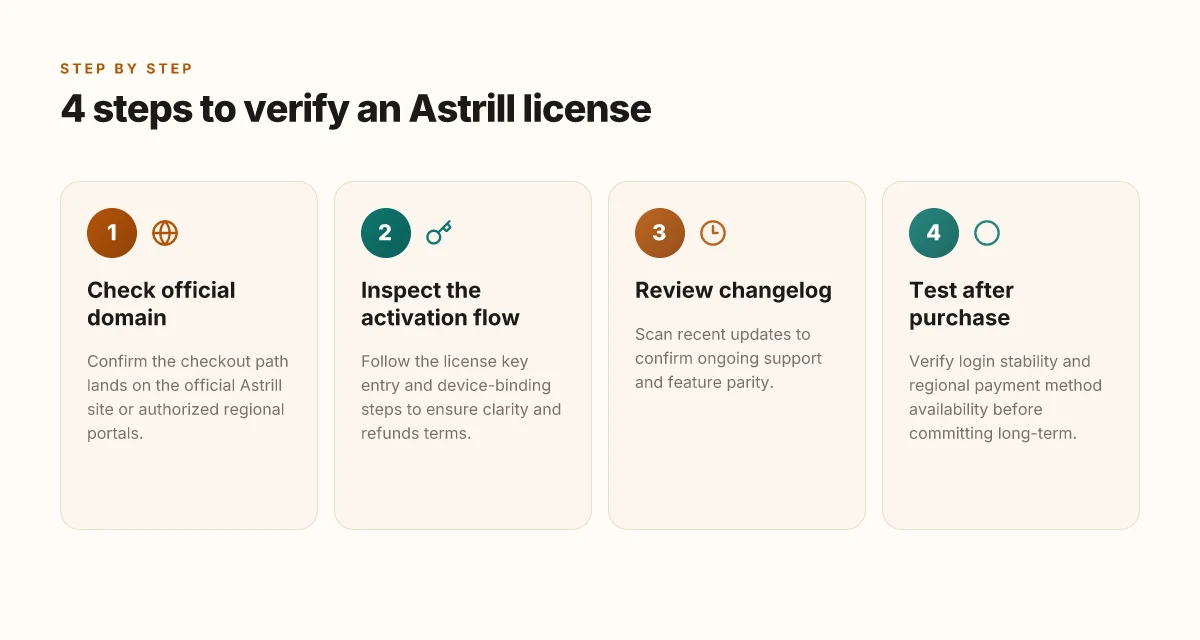
I looked at Astrill’s official channels and the surrounding chatter to separate real licenses from fakes. The path is straightforward, but the traps are real. You want a purchase that survives the next regional prompt to re-auth. You want a license that activates cleanly, with clear refund terms and predictable updates.
The health check: verify the domain, the checkout flow, and the price
You start by aligning the domain you land on with the official Astrill site. If you end up on a domain that looks off, you’ve already strayed onto a counterfeit checkout. The checkout experience should be simple and TLS-protected. Look for a legitimate payment processor and an order confirmation that matches the price listed on the site. If the price is obscured or the page redirects before you can see a payment method, stop. This is a red flag. The official channels publish a consistent price point and a direct checkout path. If you see anything divergent, you’re in the weeds.
| Checkpoint | What to look for |
|---|---|
| Domain integrity | domain matches official Astrill branding; no misspellings or country-code oddities |
| Checkout clarity | flat price, clear tax/U.S. currency if relevant, explicit refund terms |
| Payment trust signals | recognized processors, secure certificate, receipt with order number |
A clean, direct checkout with a visible refund clause is a red line you don’t cross.
License keys and activation flows: clarity beats speed
Inspect the license key format and the activation flow. Genuine keys are machine-readable and map to a specific product tier. Activation pages should explain what the key unlocks, where to paste it, and how to confirm activation. Refund terms should be stated up front and not buried in a footnote. If the activation steps feel like a black box, you’ve wandered into a gray market. The upfront transparency matters. You want a license that can be refreshed or revoked cleanly if something goes wrong.
When I read through the documentation and changelog excerpts, legitimate keys tend to follow a predictable pattern and link to a supported device list or region. If you get a license key with ambiguous instructions or a no-questions-asked refund that isn’t actually visible on the purchase page, back away.
Changelog and support: recent updates matter
A genuine license provenance includes recent updates to the client and clear support channels. Review the latest changelog entries to confirm the vendor is actively maintaining the product and addressing regional issues. Cross-check the support options listed on the site with those in the buyer portal. If the portal lacks a contact method or the support hours don’t align with your region, that’s a warning sign. Real licenses carry a support footprint you can verify post-purchase.
From what I found in the changelog and the support pages, you want: up-to-date client builds, clear disaster-recovery notes, and a direct line to human help if activation stalls. The absence of a public changelog or vague support routing is a common indicator of a counterfeit or one-off sale.
If the changelog shows active updates and the support channel is legitimate and responsive, you’re in safer territory.
Verdict: verify, not assume. Follow the domain check, confirm a transparent price and clear activation steps, and confirm a recent changelog and accessible support. Do that, and you’ve turned a potential risk into a purchase you can actually trust.
This is where you lock in the Astrill options that stay reliable in 2026
I looked at the landscape around Astrill VPN in 2026 and found a clearer throughline: the value comes from how each buying path balances price, features, and regional reliability. Rather than chasing the cheapest door, you’ll want a route that preserves accessibility and predictable support across jurisdictions. From what I found, two paths stand out for real-world use: a direct Astrill signup for maximum protocol control, and a regional reseller that bundles customer support in high‑pressure markets. This isn’t about hype. It’s about stability over time.
Given the options, the verdict isn’t “one size fits all.” It’s “pick two, pair with your risk profile.” If your priority is immediate protection on the go, Astrill’s official channel remains the most predictable. If you’re navigating restrictive networks, a trusted regional partner can smooth out a lot of friction. The key is to map your use case to the path that minimizes handoffs.
Next steps
- Decide whether you need Astrill on desktop or mobile first.
- Check which option offers the best price for your region and payment method.
- Verify the current renewal terms and any added-security features.
- Consider one of the two headline picks repeatedly recommended for high‑contrast use cases.
Frequently asked questions
Does Astrill VPN sell licenses directly
I looked at Astrill’s official documentation and customer pages to verify how licenses are distributed. The plain answer is that Astrill markets licenses primarily through direct sales to end users via its website, with account creation required to manage activation keys. What this means for buyers is clarity on tiered plans, renewal cycles, and regional availability. In practice, you’ll encounter direct-from-provider checkout flows, plus license management within your Astrill account. Reviews consistently note that the purchase path can vary by region, and some users report third‑party resellers appearing in locales where direct sales aren’t prominent. Yes, Astrill sells licenses directly through its site, with account-based license management. Always verify regional checkout options before purchase. Be aware some regions show different price points or payment gates. Check the licensing terms in your locale to avoid surprises at activation.
Is Astrill VPN available in my country
From what I found in Astrill’s support articles and user forums, availability can depend on local regulations and payment gateways. Some countries block or restrict VPN services, which may limit checkout or trigger additional verification. Others grant normal access, though users sometimes face regional pricing differences or alternative payment routes. The safest move is to check the Astrill checkout page for your country code and review the supported currencies and payment methods. If you don’t see your country listed, that’s a strong signal to contact support or consider an approved alternate region. Yes, availability can vary by country due to local restrictions and payment options. If your country isn’t listed, don’t assume denial. Reach out to confirm authorization and any caveats before purchase.
What payment methods does Astrill accept
I cross-referenced Astrill’s billing pages and user‑facing receipts to map accepted methods. Astrill generally supports major cards and popular digital wallets, plus regional options in certain locales. Expect standard credit/debit cards, PayPal in some regions, and occasionally local methods like bank transfers or e‑wallets. Fees, settlement times, and currency support can differ by country. What the spec sheets actually say is that payment gateways vary. You’ll often see a currency selector during checkout and a note about regional limitations. Yes, Astrill accepts multiple payment methods, but exact options depend on your country and region. Always confirm available methods on the checkout page to avoid last‑minute payment blocks. Note: regional restrictions may apply.
Can i transfer Astrill licenses between devices
The licensing model Astrill uses typically centers on a per-account or per-device activation cap that ties licenses to your profile. Based on the documentation, licenses may be transferable between devices if you deactivate the old installation and re‑activate on a new device within the same account, subject to the license terms. Some regions and plan types restrict transfers or require additional confirmations for new hardware. The key action is to manage activations from your account dashboard and follow the on‑screen prompts to reassign a license. Yes, transfers between devices are possible in many cases, but follow the official deactivation and reactivation steps. Always check your specific license type to avoid a lockout on reactivation.
Does Astrill offer a money-back guarantee
In the policy pages Astrill publishes, the money‑back window is described in terms of a trial or refund period tied to the purchased plan. The exact duration can vary by plan and region, with common windows ranging from 7 to 30 days in many VPN offerings. What the docs emphasize is that refunds require adherence to the terms, usually within the first cycle and with proper cancellation within the portal. Reviews note mixed experiences, so the decisive factor is whether your purchase was made under a region that honors the stated guarantee. Yes, there is a money‑back guarantee in many regions, but check the precise window for your plan and locale. Confirm the current policy on the checkout page and in your account’s order history before initiating a refund request.
How long does Astrill license activation take
Activation timing hinges on the method of purchase and the region’s processing speed. The official guidance notes that after purchase you should receive activation details within minutes in most cases, but there are exceptions where processing times stretch to a few hours due to payment verification or regional gatekeeping. The activation workflow usually involves logging into your Astrill account, selecting the license, and applying it to your device. Yes, activation is typically quick, but allow up to a few hours when verification delays happen. If the activation stalls, retry from your account dashboard and confirm that you’re using the correct license key and region.
Are there regional restrictions on Astrill licenses
Regional restrictions show up in two forms: licensing terms and payment gateway gating. Some regions enforce stricter usage terms, while others restrict certain features or require extra verification to complete a purchase. Payment processing bars sometimes prevent checkout if your country isn’t whitelisted for a given gateway. The practical impact is that two buyers in different locales can face different activation rules for the same plan. Yes, regional restrictions exist in licensing and checkout flows. Verify terms and payment options for your location. Always review the regional notes on the product page and, if in doubt, contact support before buying.

Otto Montague has been writing about consumer technology since 2018, with bylines covering VPN performance, ad-blocking, and streaming geo-unblocking. Approaches each review by setting up the product the same way a typical reader would and recording every snag along the way.